
'The book has immense value because it reveals the inner workings of the think-tank which appears to provide facts and insights to Modi, though he himself takes the final decisions and articulates them in his characteristic rhetorical style,' says Ambassador T P Sreenivasan.

'China might soon have to seriously consider whether it prefers an Indo-US hyphenation to a Sino-Indian one.'
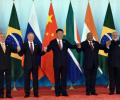
The BRICS also called upon all nations to adopt a comprehensive approach in combating terrorism including countering radicalisation and blocking terror financing sources.

'While economic ties are making incremental progress, it is in the security and strategic domains that the India-Japan synergy is more compelling,' says Dr Rajaram Panda.

With the situation in Ladakh tense and no resolution in sight the trigger to take the India-US relationship to a transformational one is already there, observes Lieutenant General Syed Ata Hasnain (retd).

Leaders of the Shanghai Cooperation Organisation gathered for their 5th summit in Shanghai

United Nations chief Ban Ki-moon on Thursday asked Iran to build "international confidence" in its nuclear programme by fully complying with the global obligations under NPT and cooperating with IAEA, shortly after Tehran slammed the UNSC for being "unjust and completely undemocratic".

The dreary, cold months from December to February may prove to be the undoing of many a nation as they grapple with sky-high fuel prices - a result of the Ukraine conflict and the pandemic. Many - Europe, South Korea, Japan, and China - will still pull through on the strength of their wealth or because of strong storage infrastructure. But India will have its back to the wall. Signs of liquefied natural gas (LNG) rates hitting new records this winter are already evident.

Prime Minister Narendra Modi enjoys a close relationship with Shinzo Abe. For Abe, "a strong India is in the best interest of Japan, and a strong Japan is in the best interest of India."

'One must remember that a dragon has a forked tongue,' warns Vivek Gumaste.
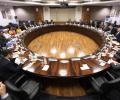
'India appears to have stood its ground on strategic autonomy by resisting US pressure on Russia, China and Iran, but succumbed to the temptation to walk into a tighter embrace in defence cooperation, a high priority of the Trump administration,' notes Ambassador T P Sreenivasan.

The US is not going to be able to mount a concerted 'Western strategy' against China or Russia in the present international milieu, predicts Ambassador M K Bhadrakumar.

'If the Russian forces do capture Kyiv and set up some sort of provisional government, they might run into an insurgency, for which the geography is just right, it could prove costly for them.' 'In that event, the whole exercise could turn out to be counter-productive -- and costly in both foreign policy and domestic terms.'
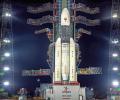
Lack of access to the cosmonaut training programmes would also be a hindrance for ISRO's planned manned missions, explains Devangshu Datta.

The only thing that may salvage Narendra Modi's trip to the US is his meetings with CEOs, such as those of Blackstone, First Solar, Qualcomm, Adobe, and General Atomics, asserts Rajeev Srinivasan.

The former Chief of Army Staff said India faces the most complex threats and challenges spanning a full spectrum of possible conflict -- from nuclear to sub-conventional -- but asserted that the armed forces are ready to deal with them.

India cannot choose its geography and devise regional strategies to dovetail into the Western Indian Ocean hypothesis conceived in the Pentagon, argues Ambassador M K Bhadrakumar.
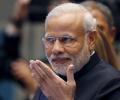
The Chinese state media on Tuesday labelled India as a spoiled, smug, self-centered, self-righteous nation after Beijing faced massive criticism for blocking New Delhi's bid for membership to the Nuclear Suppliers Group.

The ecosystems of India and China today jostle against one another across Asia and much of the world.

Not just Vietnam, but other countries in the region like Philippines, Malaysia and Thailand, have also expressed an interest in acquiring the BrahMos cruise missile. Debalina Ghoshal explains the significance of the move.

Pakistan has claimed that its credentials for membership of the Nuclear Suppliers Group are "stronger than India" if the elite club agrees on uniform criteria for non-Nuclear Non-Proliferation Treaty states to join the group.

An agreement to expedite the Jaitapur nuclear plant was expected to be signed.

'This novel format of diplomacy -- the informal summit -- will not only facilitate bilateral communication and reduce miscalculations at the very top level of the two governments, but possibly open the space for China and India to speak in one voice on various issues of mutual concern,' note Feng Renjie and Ding Kun Lei

Aziz Haniffa/Rediff.com listens to four Indian and American national security advisers recalling the hard work that went into negotiating the nuclear deal.

Modi will hold several bilateral meetings with the leaders of the SCO member countries including China's Xi Jinping.

'The Modi-Xi and Modi-Obama meetings, with an interval of just 12 days, are juxtaposed superbly at a crucial point in the prime minister's life. Can Modi carve out a win-win situation with the superpower and the emerging superpower at the same time?'
The United States, he said, 'desires a new age of ambition' in its relationship with India. Asserting that the US has never been more supportive of India's security, he said New Delhi too, is an important partner and a key pillar of President Trump's foreign policy.

China continues to hold out on fingering Pakistan as the 'mothership of terror,' declaring Masood Azhar a terrorist at the UN, and India's membership of the NSG, says China expert Srikanth Kondapalli.
India, along with Pakistan, is set to be inducted as full members into the bloc, which mainly deals with issues relating to security and defence.
'India and China have to make concrete progress with regard to the border issue, addressing the trade deficit, and facilitating people-to-people interactions. This has to happen in the next two, three years.' China expert Tansen Sen tells Sheela Bhatt/Rediff.com how India and China can take their relations to the next level.

'It is unrealistic to expect that security dilemmas and strategic distrust to disappear or even diminish any time soon,' says Rup Narayan Das.

Sujatha Singh stands for the right values and quite simply, she's a "good person" who understands complex economic issues thoroughly, say her friends.

After Pyongyang tests a missile potentially capable of reaching the US, Dr Rajaram Panda explores the realistic -- and peaceful -- options before Donald Trump and the international community at large.

Asserting that it will continue to engage Iran in bilateral economic activities, India on Thursday said any issue that Iran has with other parts of the world should not impede "legitimate economic interaction" of the two countries.

'The question remains: Was the Obama visit truly a success? Only the future will tell us if the "breakthrough" in the nuclear liability issue will concretise into electricity.' 'As importantly, it will be interesting to watch how India's relations with China will evolve in the months to come.'

Addressing the media jointly with Modi after hour-long talks at the White House, Obama said it was natural for India and the US, two biggest democracies, to 'deepen and broaden' partnership.
The statement says the new phase in ties between the nations beginning today will enhance cooperation in 10 sectors including the economy and defence
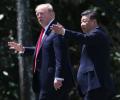
Trump aides, who participated in the two-day talks held at the US President's Mar-a-Lago resort in Florida, described the meetings as productive and said the two leaders exhibited "positive" chemistry.

The terrible beauty of Doval's initiative is that it is all about a new journey rather than about a set compass pointing toward a pre-determined destination, observes Ambassador M K Bhadrakumar.

'If, as appears to be the case, India is on way to 'mending fences' with China, and China is equally desirous to 'reset' the relationship, this could be a self-reflexive moment in India's positioning vis-a-vis not just the Dalai Lama, but also the Tibetan issue and China as a whole,' points out China expert Alka Acharya.
 © 2026 Rediff.com - Advertise with us - Disclaimer - Privacy Policy - Sitemap - Feedback - About us - Terms of use - Grievances